
Does a sauna on Mallorca need a building permit?
What Balearic law actually says — and why "it isn't fixed down" stopped being an argument in December 2024
Search this question in English and you get almost nothing useful. You find guidance written for the UK, generic advice from sauna retailers in countries with entirely different planning systems, or a sales page telling you not to worry about it.
Mallorca runs on Balearic law. It works differently from what most owners expect, and the differences matter before you order, not after.
The first surprise: "obra menor" and "obra mayor" are not legal categories
Everyone on the island uses these words. Your neighbour, your builder, probably your estate agent. Minor works, major works — it sounds like a clear statutory line.
In Balearic planning law that line does not exist. Ley 12/2017 de urbanismo de las Illes Balears (LUIB) does not use those categories. It sets out three tiers instead:
| Tier | Legal basis | What it means |
|---|---|---|
| Licencia urbanística | Art. 146 LUIB | A real permit. You may not start until it is granted. |
| Comunicación previa | Art. 148 LUIB | A notification. You file it and may begin immediately. |
| Exempt | Art. 145.2.a) LUIB | Very narrowly defined — see below. |
"Obra menor" survives in municipal ordinances and in case law. Palma still has an Ordenanza de obras menores y menores simples dating from 2002. But Spain's Supreme Court has expressly called it an indeterminate legal concept, to be judged case by case on the scale of the works, their effect on planning, and their technical complexity.
Which means: there is no table you can look it up in. There is a classification, and your town hall makes it.
The exemption — and why it can never cover a garden sauna
Art. 145.2.a) LUIB sets out the one quantified exemption. Works are entirely exempt only if they meet all of these:
- on suelo urbano (urban land),
- with a budget under €3,000 (not stackable across several jobs at the same location within a year),
- carried out entirely inside an existing building,
- requiring no proyecto técnico,
- and the building is not listed as BIC, not catalogued, not fuera de ordenación, and no protected elements are affected.
Read the third condition again. Entirely inside an existing building. A garden sauna is by definition outside one. This exemption can never apply to an outdoor model, whatever its size or price.
That also disposes of one of the most persistent claims circulating on Spanish garden-building websites: that anything under 10, 15 or 20 m² needs no permit. No Balearic legal instrument sets a square-metre threshold. The only quantified limit in the LUIB is the €3,000 figure, and it applies indoors only.
The outdoor sauna: where it gets serious
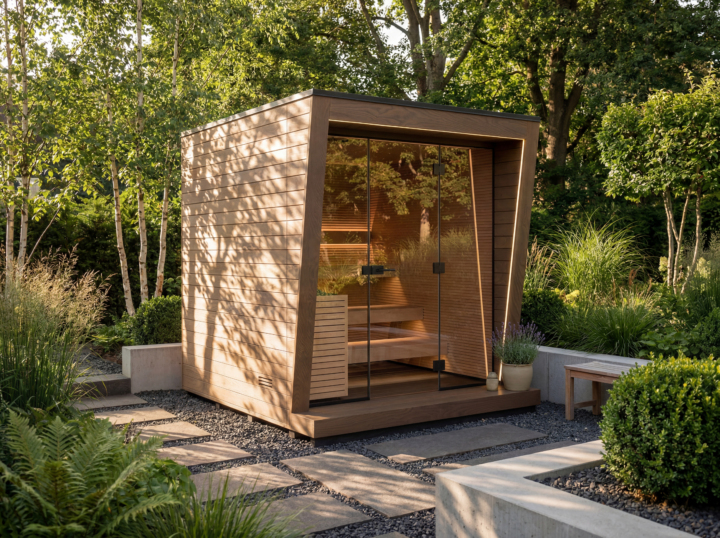
Art. 146.1 LUIB lists what requires a permit. Point e) covers prefabricated houses and similar installations — expressly whether they are placed temporarily or permanently. The same wording appears in Spanish national law, at Art. 11.4.c) of Real Decreto Legislativo 7/2015.
A prefabricated sauna cabin, delivered and set down as a unit, is exactly that: an installation similar to a prefabricated house.
And that closes the door on the simpler route. Art. 148.2 LUIB expressly forbids island councils from extending comunicación previa to casas prefabricadas. If your town hall classifies the cabin that way, a permit is not one of two options — it is the only one.
"But it's movable" — that argument died in December 2024
The most common sales line is that the cabin is not anchored, therefore not a building, therefore no permit.
Spain's Tribunal Supremo rejected that on 5 December 2024 (appeal 7459/2022). The court put mobile homes on the same footing as prefabricated houses and refused to treat them as vehicles or trailers. The reasoning is what matters: such structures are intended to remain on a specific plot, and they are connected to water, electricity and drainage. That makes them permanent installations despite any theoretical mobility. The judgment sets binding doctrine.
Applied to your sauna: a cabin with a fixed electrical supply meets precisely the criterion the court relied on. Anyone telling you it is fine because you could move it later has not read the current case law.
Rústico is stricter
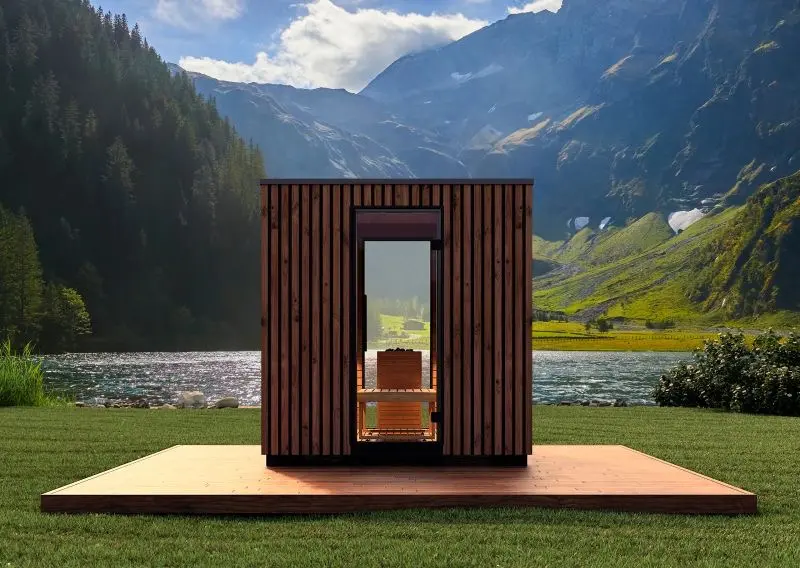
If your finca sits on suelo rústico — and a large share of detached houses on Mallorca do — three things tighten.
First, Art. 148.2 LUIB excludes suelo rústico protegido from comunicación previa entirely. On ANEI, ARIP or APR land there is no route around a permit.
Second, and this is the sharpest provision: Art. 20.1 of Ley 6/1997 del Suelo Rústico de las Illes Balears states that where works involve movable or prefabricated elements, they are subject to the same authorisation requirements as new permanent buildings. The Balearic legislator neutralised the mobility argument here back in 1997 — decades before the Supreme Court reached the same conclusion.
Third, the cabin may count against your plot's development limits. Under the Plan Territorial Insular de Mallorca, permitted site coverage runs at roughly 3–4 % depending on landscape unit and protection status, and floor-area ratio at roughly 2–3 %.
Here we have to be straight with you: whether a small ancillary structure such as a sauna cabin counts towards those figures is not expressly settled in any Balearic instrument we could access. Our reading is that an enclosed, roofed volume is normally countable unless the municipal plan exempts it. If your plot is already close to its ceiling, that may be the binding constraint — before the permit question even arises. Have an architect check it. We would advise against relying on any opinion given without sight of your file, including ours.
Penalties on rústico are severe. Fines are calculated as a percentage of the value of the works, materially higher on unprotected rústico than on urban land and higher again on protected rústico, together with an order to restore the original state. An unpermitted garden sauna is not a minor infringement.
The indoor sauna: usually straightforward
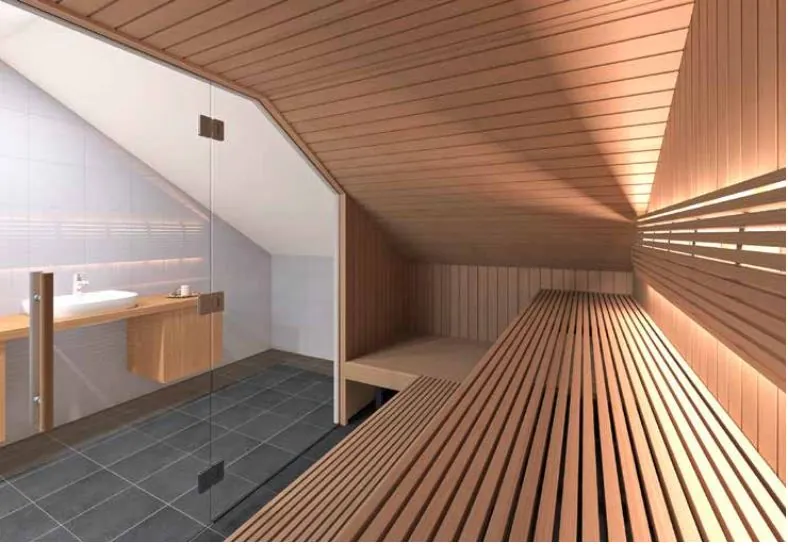
Fitted into an existing room — a cellar, a guest bathroom, a spare room — the picture is far more relaxed.
Stay under €3,000, on urban land, in a building that is neither protected nor catalogued, with no proyecto required, and Art. 145.2.a) LUIB applies: there is nothing to file.
Above that, expect a comunicación previa. Palma's Modelo 1 form expressly lists electrical installations inside a dwelling as notifiable rather than permit-requiring work.
A full permit becomes necessary only if you touch structure or foundations, change the number of dwellings, change the use of the room, or if the building is BIC, catalogued or fuera de ordenación. In Palma's old town and in protection zones, even a notification goes through the stricter Modelo 3.
One point that is not settled: the €3,000 refers to the works budget (PEM). Whether the purchase price of a factory-built cabin counts as construction or as equipment is not addressed in any source we could find. If in doubt, ask your town hall before relying on the exemption.
Coast, Serra de Tramuntana and protected buildings
On the coast, Ley 22/1988 de Costas establishes a servidumbre de protección of 100 metres inland as a general rule. Art. 25.1 prohibits, among other things, buildings intended for residential use. A sauna cabin is not a dwelling and so is not automatically caught — but works within that strip need authorisation from the autonomous community in addition to the municipal permit. Transitional rules can shorten the strip in defined circumstances. These provisions are complex and case-specific; settle them before you order.
In the Serra de Tramuntana and for listed or catalogued buildings, the Art. 145.2.a) exemption falls away entirely and Art. 148.2 rules out comunicación previa. Expect a full permit even for small work, an additional heritage report from the Consell de Mallorca, and considerably longer processing.
Setbacks are not uniformly regulated. On rústico, Ley 6/1997 Art. 29.2.a) requires only distances sufficient to preserve the free-standing character — a principle with no number attached. In urban areas the figure comes from your municipality's plan and from your specific plot's zoning.
And the cédula de habitabilidad?
In short: normally unaffected.
A new first-occupancy cédula is triggered by new build, extension, conversion or refurbishment affecting more than 60 % of the layout. Fitting a sauna into an existing room falls below that and creates no new habitable area.
It can become relevant if the sauna forms part of a larger refurbishment that crosses the threshold. We could find no Consell de Mallorca guidance addressing saunas specifically. The cédula is valid for ten years and is issued by the Consell Insular.
What we would advise
- Establish your land classification first. Urban or rústico, protected or not — everything else follows from it. It is on your nota simple, or ask the ayuntamiento.
- Ask your own town hall. Palma, Calvià, Andratx, Pollença and Santanyí each apply their own plans and ordinances. There is no single Mallorcan answer, and anyone who gives you one is oversimplifying.
- On rústico, in the Serra, near the coast or on a protected building: talk to an architect before you order. Not after.
- Budget for the permit. In Palma, for example, a fee of 2.61 % plus the ICIO construction tax of 4 %, both calculated on the works budget excluding VAT, professional fees and contractor's profit.
- Allow time. In protection zones, several months is realistic.
How we handle it
We supply and install Auroom saunas across Mallorca. At the site survey we look at where the cabin is going, how the plot is classified and what that means procedurally — before anything is ordered.
What we will not do is tell you a garden sauna will be fine because it can be moved. After the December 2024 judgment, that is simply not true.
If you want to know where you stand, send us photos of the location and the name of your municipality, and we will tell you which questions to put to your town hall.
As at August 2026. This article reflects the legal position as we researched it and is not a substitute for legal or architectural advice. The LUIB was last amended in June 2026; municipal ordinances change independently. For your specific project, your town hall's answer is the one that counts.