
What electrical supply does a sauna need on Mallorca?
Potencia contratada, the boletín eléctrico, and whether you really need three-phase
Look up what a sauna heater needs and you will almost certainly land on an American or British page. Breakers, amps, the National Electrical Code. None of it applies to a finca near Santanyí.
Spain runs on the Reglamento Electrotécnico de Baja Tensión (REBT, RD 842/2002). And the question that actually decides your project on Mallorca is usually not the wiring — it is your potencia contratada, the power you have contracted with your supplier.
The point most owners underestimate
A 6–9 kW sauna heater is not a minor load. It is roughly the size of your entire household.
According to CNMC household data for the first half of 2025, around 43 % of Spanish households contract between 4 and 6 kW, and a further 28 % are under 3 kW. Which means that for roughly seven households in ten, the sauna heater alone exceeds the whole supply.
And you will not be running it in an empty house. Fridge, lighting, air conditioning, possibly a pool pump all carry on. Realistically you need capacity for the heater plus base load — in practice 9.2 to 14.49 kW single-phase, or three-phase.
The Spanish domestic tariff band 2.0TD covers up to 15 kW, so you normally stay in the ordinary domestic band even after an increase.
Do you actually need 400 V three-phase?
This is the most expensive wrong assumption in the whole subject, and the answer is often no.
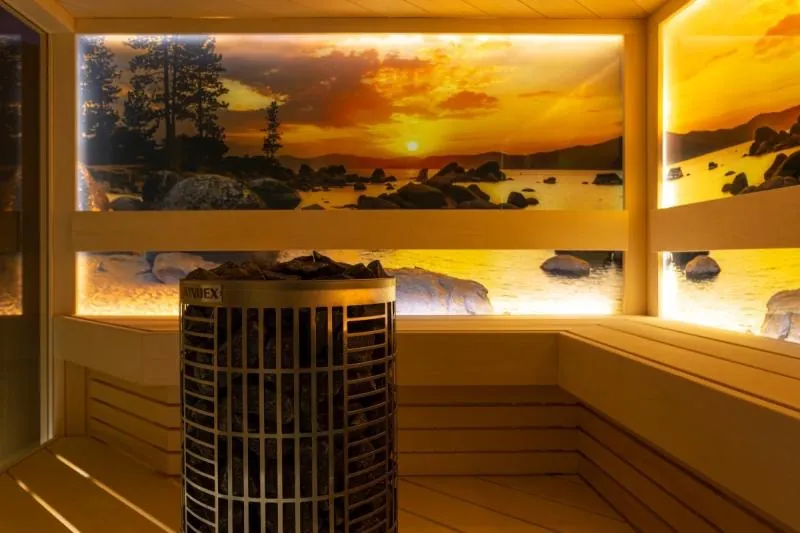
Many sauna heaters between 6 and 9 kW are rated for both. The installer wires the terminal block accordingly. The Harvia Cilindro PC70 at 6.8 kW, for instance, is specified by the manufacturer as "400 V 3N or 230 V 1N". Other European manufacturers publish comparable wiring tables.
Two practical limits are worth knowing:
- An 8 kW heater at 230 V draws roughly 35 A. That requires adequate cable cross-section, the right protective device, and enough contracted power.
- Above roughly 9 kW, many heaters are three-phase only.
Important: whether a particular model can run single-phase is stated in that model's manual. Do not rely on general claims — including ours. We check it for the specific heater before any quotation goes out.
What about a phase converter?
A phase converter produces a three-phase supply from a single-phase connection. The question comes up constantly, because many houses on Mallorca have no three-phase supply.
Our research on this is clear, in an inconvenient way: we found no provision in Spanish electrical regulation that recognises a phase converter as a route for running three-phase loads on a single-phase domestic supply. The REBT contains no instruction on them, and we found no Spanish professional source recommending the approach.
That is an absence of evidence, not proof of illegality — CE-marked equipment installed in compliance with the REBT is not unlawful in itself, and the installer would have to certify the installation in the Certificado de Instalación Eléctrica. But it is not the normal route in Spain. The normal route is adapting the supply.
And in the great majority of cases it solves a problem you do not have, because the heater can run single-phase.
What the REBT requires for saunas
There is a dedicated instruction: ITC-BT-50, "Instalaciones eléctricas en locales que contienen radiadores para saunas." It is very short, and refers the technical requirements onward to standard UNE 20460-7-703, which holds the zones, IP ratings and cable temperature requirements.
We deliberately quote no figures from it. The standard is paid-for, and we do not reproduce technical values we have not read in the original. Your authorised installer works from it.
It is often confused with ITC-BT-27, the instruction for rooms containing a bath or shower. That one expressly does not cover saunas and points to ITC-BT-50 itself. If your sauna sits in a bathroom that also has a shower, both apply to that room.
On electrification level: ITC-BT-25 defines grado básico at 5,750 W and grado elevado at 9,200 W. The higher level is required for dwellings over 160 m², where air conditioning is planned, and where electric heating is planned, among others. A sauna heater is not named there, but in practice it runs on a dedicated circuit, and a house with a sauna will normally sit in the grado elevado.
The boletín eléctrico: when do you need a new one?
The Certificado de Instalación Eléctrica (CIE), commonly called the boletín, is issued by an authorised installation company and signed by a qualified installer. It records the installation's characteristics and its intended power, and certifies compliance with the REBT. This is governed by ITC-BT-04.
Good news first: a sauna never triggers a proyecto técnico. Under ITC-BT-04, a project is required for single dwellings only above 50 kW. A 6–9 kW heater is far below that; a memoria técnica de diseño suffices.
A new boletín becomes necessary, according to the distributor e-distribución, when:
- the requested power exceeds the maximum shown on your current boletín,
- more than 20 years have passed since e-distribución last verified the installation,
- the supply type changes, i.e. single-phase to three-phase,
- and — expressly for the Balearic Islands — a specific verification determines that one is needed.
That last point is a Balearic particularity that e-distribución states itself. What the verification involves in practice is worth asking about directly in your case.
If your contracted power is unchanged, the modification to the fixed installation still has to be documented by the installer — whether a new CIE is registered with the Govern depends in practice on whether the installation's maximum permissible power changes. Your installer will settle that.
Registration: the CIE is registered with the Direcció General d'Industria i Energia of the Balearic government, in person in Palma or through the CAIB electronic office. A fee applies.
What a power increase costs
The one-off regulated connection charges are set nationally (Orden ITC/3519/2009):
| Item | Amount |
|---|---|
| Derechos de extensión | €17.374714 per kW |
| Derechos de acceso | €19.703921 per kW |
| Derechos de enganche | €9.044760 flat |
| Derechos de verificación | €8.011716 flat |
Extensión and acceso are charged on the additional kilowatts only. VAT is added.
Worked example: increasing from 5.75 kW to 11.5 kW, so plus 5.75 kW.
- Extensión: 5.75 × €17.374714 ≈ €99.90
- Acceso: 5.75 × €19.703921 ≈ €113.30
- Enganche: €9.04
- Around €222 net, roughly €269 including VAT.
That is the cheap part. Two things cost more:
First, the ongoing capacity charge. A higher contracted power raises your monthly standing charge for the life of the supply. Rates change, so have your electricity supplier calculate it for your tariff before you increase. Over the lifetime of the sauna this outweighs the one-off fees considerably.
Second — and this is the real risk on Mallorca — the network works. e-distribución distinguishes between acometida a baremo, where the distributor carries out the work at the fixed rate of €17.37 per kW, and presupuesto, an individual quotation. The fixed rate applies on developed urban land. On a finca with a long or weak supply line you can quickly end up in the quotation route — and then you pay for the network extension. That can differ from the €222 in the example by orders of magnitude.
If your property is remote, settle this before you order the sauna.
The process with e-distribución
On Mallorca, e-distribución (Endesa group) is the network operator. A power increase runs like this:
- Application, with current and requested power, location, and the CUPS of your existing supply.
- Technical and economic study — baremo or individual quotation.
- Terms issued. Valid 30 working days; 6 months under baremo.
- Acceptance by payment.
- Network works by the distributor.
- Verification of your connection installation, which you adapt through an authorised installer.
- Contract with your supplier — the CIE is one of the required documents.
Regulated response times are under three weeks up to 100 kW, halved under the abbreviated regime for supplies not exceeding 15 kW. Suppliers report one to three weeks in practice.
Changing from single-phase to three-phase alone costs only the derechos de enganche — around €10.94 including VAT — provided the power stays the same. Both can be combined in one application at no extra administrative cost.
One detail with consequences: contracted power may generally be changed only once every twelve months. Get the calculation right first time, with headroom for the heater, base load, and whatever else you may add over the next few years.
Four questions to settle before you order
- What is your current potencia contratada? It is on your electricity bill.
- Can the chosen heater run single-phase? It is in that model's manual, not in the brochure.
- Is your capacity enough for heater plus base load, or do you need an increase?
- Is your property within the baremo regime, or is an individual network quotation likely?
How we handle it
We settle those four points at the site survey, before a quotation goes out. Standard installation covers assembly, connection, test run and handover — the final electrical certification is carried out by an authorised Spanish installer, so your installation is properly documented and registered with the Govern.
What we will not do is sell you a sauna and leave the supply question with you. That is the most common reason a delivered cabin sits unused for weeks.
More on thisDoes a sauna on Mallorca need a building permit? — why "it isn't fixed down" stopped working as an argument in December 2024.
As at August 2026. The charges and procedures given here reflect our research. The specific requirements for your installation are determined by your authorised installer; binding information on the network connection comes from e-distribución.